Archives

Why Mr. Darcy is Such an Appealing Romantic Hero

Okay, so I’ve been trying to figure out what makes Mr. Darcy stand out in the crowd of romantic heroes. Among Austen’s leading men he’s definitely the biggest star. Other romantic heroes from Austen’s period and from ours just don’t have the same powerful grip on our imagination. So, what sets him apart from other romantic heroes? Here are some of thoughts:

1. He is steadfast – he doesn’t give up on her, even after she turns him down.
2. He is willing to overlook her family — yeah, it takes him a while to get there, but he must love her an awful lot to put up with Mrs. Bennet, Lydia and Wickham. Talk about difficult in-laws…
3. He likes her intelligence – This is a biggie. He does think she has fine eyes, but what he really likes is her wit, cleverness, lively conversation. Wouldn’t every woman like to be appreciated for her brain?
4. He values her backbone – One of the first things he notices about her is that she stands up to him. I always assume most women treat him like Miss Bingley, fawning over him and agreeing with everything he says. Darcy likes Elizabeth because she’s her own person.
5. He defends her to other people – Isn’t this a female fantasy? A guy who will tell other people (including catty women) you’re beautiful and smart when they’re criticizing you.
6. He fixes problems for her — Yeah she generally takes care of her own issues, but she can’t fix the Lydia/Wickham thing. He wades into the scandal for her sake without even asking for any credit.
7. He’s played by Colin Firth (and that other guy who’s kind of cute too).

But the biggest reason of all: He is willing to change his behavior for her. He admits he was wrong and tries to be a better person so he can deserve her.

I think this is the characteristic that sets Darcy apart from most other romantic heroes. Yes, many of them change and make sacrifices for their loved ones, but few make the kind of deep alterations to their character that Darcy does. Deciding you’ll give up your womanizing and gambling for her sake just doesn’t compare. He essentially starts as a selfish character and evolves into one whose primary consideration is the happiness of the woman he loves. Who wouldn’t love that guy?

Okay, so that’s my take. What does everyone else think?

Some of My Favorite Things (in an Austen Variation)

As I write my next P&P variation, I have spent a lot of time thinking about what I like in my Jane Austen variations – and, naturally, what I don’t like.

One of the things I look for in all my books is passion, emotion, true feelings. In life it might not be realistic to believe that two people must be together to be happy, but I love to see that premise in my novels. So, I look for these extremes of emotion in my Austen variations as well. If the characters aren’t feeling like this is one of the most important moments in their lives, why should I care?

However, in order to have extreme emotions (or an interesting plot), you need conflict; bad things need to happen to your protagonists. They can’t be happy – particularly at the beginning. I’ve read P&P sequels (taking place after the original book) in which Darcy and Elizabeth are happy most of the time. They have sex, they go to the beach, they laugh. I would love to be those people. I do not want to read about them. It’s boring.

Another thing I look for in my P&P variations is being true to the characters. I love to see variations which put the characters I recognize and love into new and interesting situations. That’s my idea of a great book – even if the situation is a bit farfetched.

Now, of course, my idea of true to the characters might not be someone else’s. I don’t mind me some sex scenes. I believe Darcy and Elizabeth would have a passionate relationship. I believe they might anticipate their marriage vows (there’s evidence lots of people did back then – particularly when engaged) under certain circumstances.

However, I can’t see Miss Bingley slipping into Darcy’s bed in the hopes of seducing or compromising him. She’s a harpy, but that’s not her style. She’s as interested in preserving her virtue and reputation as any other well-bred woman. I can’t picture Colonel Fitzwilliam becoming a letch who Darcy has to protect Elizabeth from. There’s nothing to suggest that interpretation of the character in the original text. I have a hard time imagining Jane becoming the protective head of the household after her father dies and defending a fragile Elizabeth. When did they both have a personality transplant? Mr. Collins may be a vain idiot, but would he become an evil villain? It doesn’t seem to be in his nature – plus he’s a dim bulb.

Now, maybe some readers can overlook these things. There are some improbabilities I don’t mind if they’re explained well. But for me this kind of radical reinterpretation of the characters makes it hard for me to stay in the world of the novel and enjoy it.

There are, of course, other things I like and don’t like about variations. But that’s enough for now. I’d love to hear others’ opinions. What are your favorite things about Austen variations?

Related to Jane?

So, unbeknownst to me, my cousin has been doing genealogical research and discovered we are distantly related to…Jane Austen! I couldn’t be more thrilled. Maybe the urge to write is inherited :). Of course, there are probably thousands of people who are related to her (she had a lot of brothers), but it’s still cool.

Of course, he also discovered we’re even more closely related to Richard Nixon (11th cousins or something) ….But I’ll try not to dwell on that. Hopefully the urge for politics isn’t inherited (shudder) :).

Jane Picture

The First Draft is the Hardest

I finished!!! I wrote the last scene and the last word of my first draft  (tentatively entitled Pride and Proposals) ! This is the hardest part of the process — for me and for many writers, I believe.  Once you have something on paper, and you’re not facing a blank screen, it’s so much easier to revise.  Even if you have to throw out pages and pages (and I have), you’re better off having something to work with.  That’s why I always try to write the first draft quickly (I’m not always successful) and give myself permission for it to be crappy.  If I worry about each sentence construction or word choice, I’d never get through the first page.  Those considerations are for the next draft.

So, I’m going to celebrate with some chocolate and then start on the second draft.

The funny thing is, when I finish the first draft, I always think it’s awful (because I wrote fast and didn’t worry about a lot of details), but then when I go through to revise I often think, “Hey, this isn’t so bad!”  Of course, sometimes that doesn’t happen, which is a sign that my first draft needs major surgery.  Nothing to do but get out the scalpel….

Does anyone else have this experience with their second draft?

Elizabeth-Darcy-pride-and-prejudice-couples-954325_1024_576

Why Do So Many People Want to be Writers?

Recently I’ve read two blogs by published authors talking about annoying reactions they have gotten when they have told a casual acquaintance that they write novels.  I’ve been a creative writer my whole life and I’m familiar with the scenario.  A lot of times you get a reaction along the lines of “I’m working on a novel too!”  or “I’ve always wanted to write” or “I’d write if I had more time” or “I have this great idea….” Many people seem to think that with a little time and effort, they too could be a writer just like you.

I always wonder if this happens to people in other creative professions. My guess is that if you say you’re a ballet dancer, you don’t get 45-year-old fellow party guests who say, “I’ve been meaning to take up a professional ballet career.”  You might get someone who used to take (or even is taking) ballet lessons, but they don’t have aspirations to greatness in the field.  Okay, but that’s an age thing.  What about music or art?  Although you can do some guitar playing or drawing with little or no instruction, most people would recognize that if you want to seriously pursue music or art (either as a professional or a serious amateur), you need to undertake a lot of studying and practicing.  In other words: hard work.

Writing, on the other hand, looks easily accessible as an artistic pursuit.  Everyone knows the English language, right?   You can take it up when you’re 45 or 60 or 75.  You don’t need to buy a tuba or oil paints.  Here’s the problem:  Yes, anyone can write.  However, writing well takes a lot (and I mean a lot) of practice.  I’ve been writing creatively for more than 20 years and I don’t feel like I’ve perfected it.  It also helps to get good feedback from a support/critique group and instruction. (yeah, I know some people say creative writing can’t be taught, but you can teach the techniques of effective writing in the same way you teach brushstrokes or  reading music.)  Feedback and instruction help you hone your technique, but there’s no substitute for practice.  You wouldn’t expect to go to a basketball game for the first time and sink every shot you make.  Or do a perfect pirouette at your first (or fifth or fifteenth) ballet class.  Or sculpt a coherent statue out of a hunk of marble without help.  Just because you know the basics of writing — or even if you’ve been doing writing at your job — it doesn’t mean you have developed all the techniques you need for writing a novel.

Actually, I think a lot of people know this (at least subconsciously), but don’t want to believe it.  I believe this is why writers encounter a lot of people who want to be a writer.  There’s no age limit, so it’s something you can always aspire to be.  But a lot of would-be writers have tried writing the Great American Novel and found that it’s more difficult than they expected (hence the “I’m working on a novel too” syndrome).  It’s discouraging to have a vision and then discover that your writing isn’t up to the task of creating that vision perfectly (believe me, I understand!).  But, rather than practicing their writing by sitting at the computer every day (even for 15 minutes) or honing their skills with feedback from a group or instructor, a lot of these people would rather tell themselves and imply to everyone else, that they would become great writers if only they had enough time.  It’s scary to write.  I know!  But the only way to become a good writer is to write.  A lot.

Anyway, that’s my opinion.  What do you think?

Jane Austen Museum in Bath

The Jane Austen Museum in Bath isn’t as well known as Chawton Cottage, but it is near one of the houses Jane’s family inhabited when they lived in Bath.  It does give you a great idea of what Jane’s life in Bath was like and has lots of interesting Jane-related things to view.  Plus their guides are knowledgeable and could talk about Jane Austen forever!  One of the highlights is a waxwork of Jane Austen (based on their research) similar to what you would see in Madame Tussaud’s (is there an Austen statue at Tussaud’s in London?  There should be!). I actually think the statue of Jane looks a little like Mrs. Gardiner in the 1995 production of  Pride and Prejudice.    IMG_1859IMG_1852

Happiness is Not Knowing Any Better

The picture below is of the kitchen in Jane Austen’s Chawton Cottage.  I look at it and immediately think longingly of my microwave.  I guess it’s a good thing I can’t travel back in time.  I might be a real whiner (“What do you mean dinner will take three hours to cook?” — and don’t get me started on the lack of toothpaste).  

But then I remember that the Austens were probably pretty happy about the technology they had available.  They had a stove after all, not just a fireplace.  They thought they had it pretty good.  It’s like when we had floppy disks and computers without graphics.  We didn’t know any better, so it was cutting edge and cool.  Jane and her family probably read books set in the Middle Ages and thought: “Those poor people!  They only had a primitive fireplace to cook with.”   Happiness is not knowing any better. 

IMG_1734

Jane, We Barely Knew You!

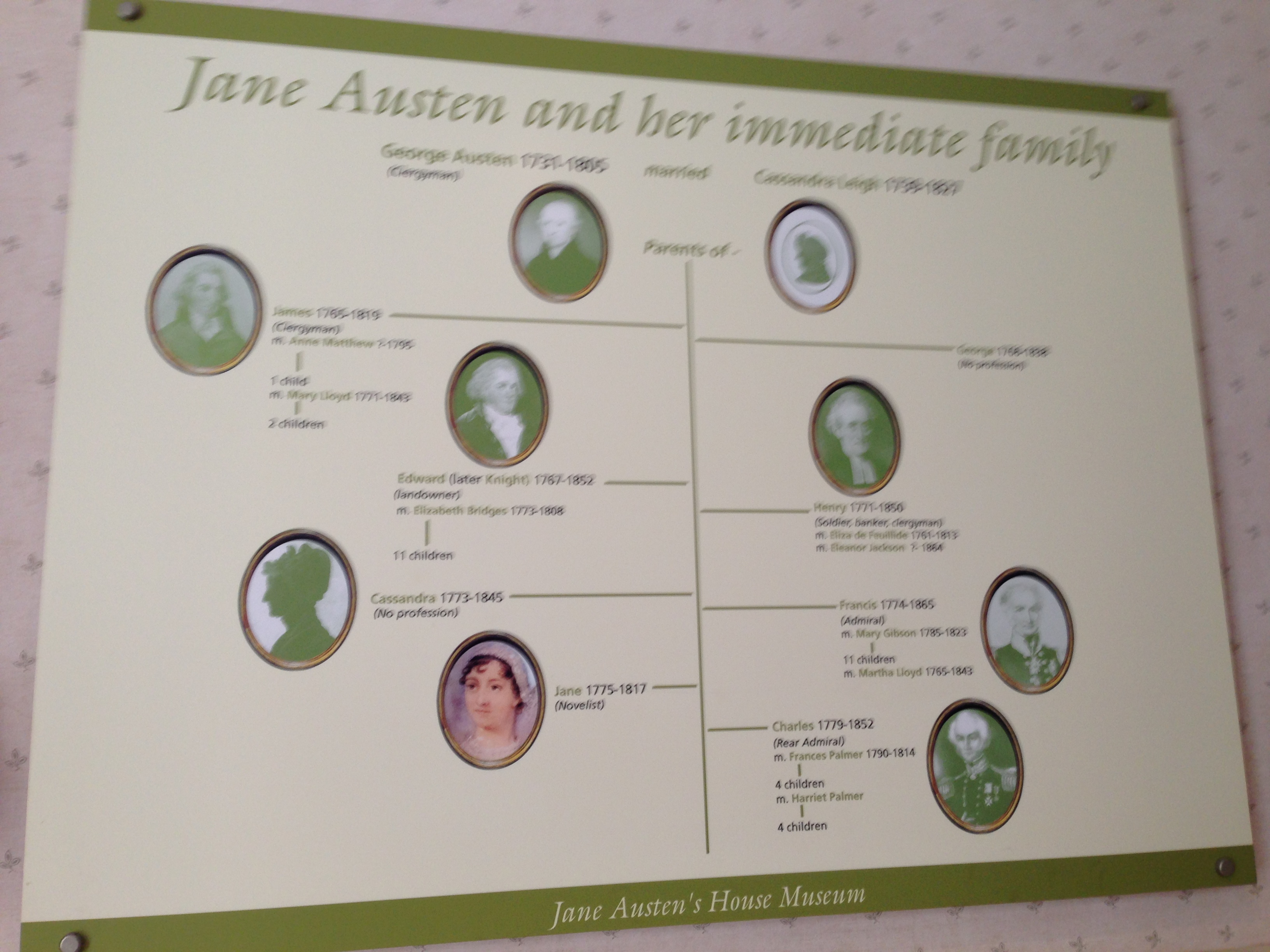
This is a family tree of Jane Austen’s immediate family — another image from Jane  Austen’s Chawton Cottage.  There are a lot of interesting things about her family.  She had two brothers who became naval officers and one who was adopted into a noble family and inherited a very nice estate.  But what strikes me the most about the family tree is how long some of her siblings lived.  She had one brother who lived until 1865 and her only sister, Cassandra, died in 1845 — deep into the reign of Queen Victoria.  Poor Jane, of course, died in 1817.

It’s astounding to think of how many novels she wrote during her short time on earth (all without Microsoft Word!).  But then imagine what she could have written if she’d lived as long as most of her brothers or her sister.  It makes me sad to think about what could have been.  Scholars are not sure what killed her, but it would probably be curable today.  Just think about all the works of art which wouldn’t be created today without the benefits of modern medicine!


IMG_1738

Jane Austen Had Writer’s Block Too!

In my recent visit to the Jane Austen house in Chawton (a charming village) and the Austen Museum in Bath, I learned a lot about Austen and her writing process.  She disliked Bath, despite having used it as a setting in more than one novel. During her time in Bath, she moved households several times and lived with constant uncertainty about her family and financial situation. Not surprisingly she wrote little during this time.  However, when she, her sister and mother established a permanent household in Chawton, she resumed writing in earnest. Undoubtedly, while she was in Bath she was thinking about the writing she had done before arriving at Bath and her time there provided fruitful material for her novels.  But uncertainty blocked her writing while stability enabled it.

I can empathize, not just because my family recently moved households.  Whenever there’s a disruption I find it hard to find the time and concentration to really focus on my writing.  I might be thinking about my writing, but it’s hard to muster the energy to put pen to paper (or fingers to keyboard).  Like Austen, I find that when things settle down again it is much easier to focus on the writing.  And when I do start writing again, it is better for my peace of mind. 

Good to know I share something with Jane!

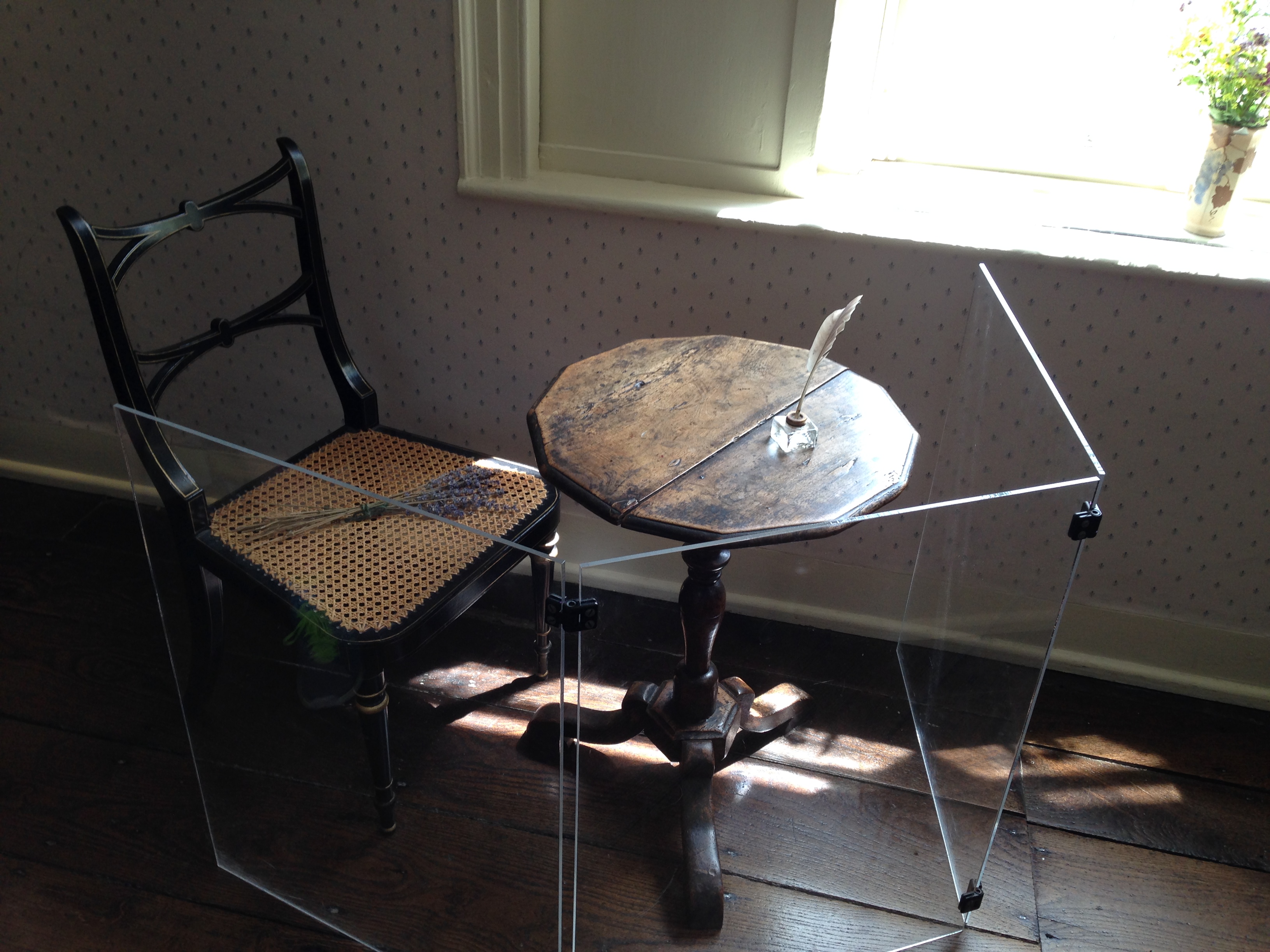
Below is a table from Austen’s Chawton Cottage where she did a lot of her writing.  It makes me thankful for my desk and laptop!

IMG_1756

Inspiration from Austen Herself — Jane’s Writing Desk!

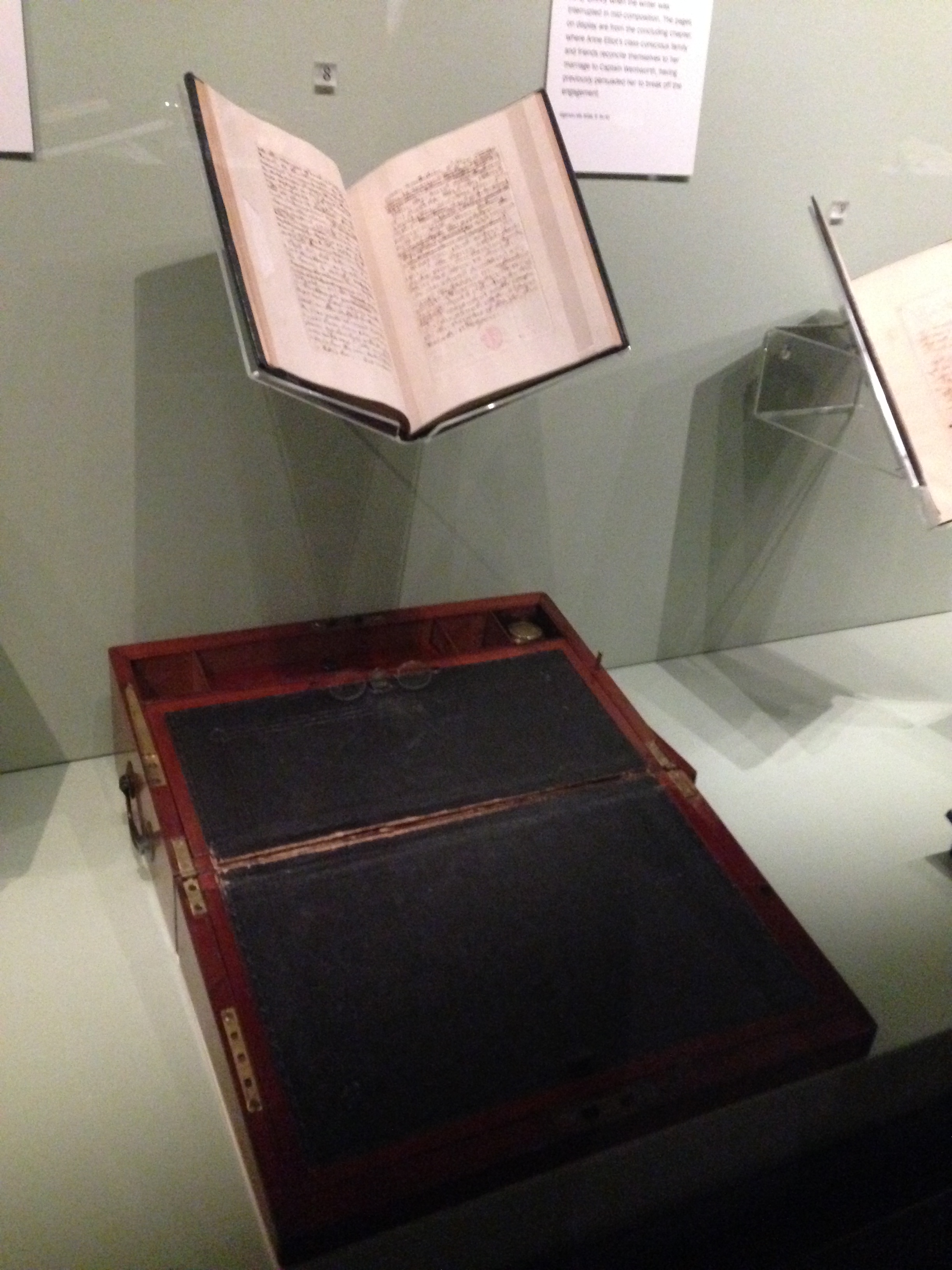
Hi Everyone.  Sorry for the long hiatus. Summer has been crushingly busy, but it included a wonderful trip to England — where I saw some truly inspirational Jane Austen sights I’ll be sharing here. This first picture is Jane Austen’s writing desk — on display at the British Library (actually the part of the British Museum that deals with documents). Above it is a first edition Pride and Prejudice.  Very exciting!

IMG_1421