Here’s an excerpt from the beginning of A Very Darcy Christmas, now available for pre-order. It will be released on Amazon on Nov. 27th.
“Mrs. Darcy, there are people downstairs in the entrance hall who say they are your parents.”
Disdain dripped off every syllable Giles uttered. Elizabeth pretended not to notice. Every day Pemberley’s butler demonstrated that he did not approve of the upstart country lass his master had married. In the months since William had brought her home as his bride, Giles’s friendliest tone of voice could be described as frosty. On the other hand, Mrs. Reynolds, the housekeeper, and the majority of the other staff had been most welcoming.
Elizabeth rushed to her feet. Her parents should be safely ensconced at Longbourn for the Christmas season. What could have brought them to Pemberley unannounced?
She hurried from her sitting room and followed Giles down the grand front staircase, her heart contracting with every step as she imagined what kinds of evil might have befallen her family. Her mother and father were indeed standing in the hall.
Their rumpled, travel-worn attire contrasted noticeably with the grandeur of the room. The inhabitants of Pemberley called it the marble hall because of the black and white marble squares covering the floor as well as the classical statues set in niches along the walls.
It was an impressive room, meant to stir amazement in Pemberley’s newly arrived visitors, and from the expressions on her parents’ faces, it was having the desired effect. Elizabeth had been duly impressed when she had first arrived at Pemberley, but now the room reminded her of a mausoleum, grand and cold and forbidding. She and Mrs. Reynolds had recently finished decorating the room with holly, evergreen boughs, ivy, and mistletoe for the yuletide season. The greens softened the room’s sharp edges, but it was only slightly more welcoming.
Her father’s careworn face relaxed into a smile when he saw her as if her presence made the unfamiliar surroundings more bearable. He does not seem overly alarmed; perhaps the situation is not dire. However, the moment her mother noticed Elizabeth, she commenced fluttering her hands and breathing rapidly as if she had experienced a terrible shock.
In other words, everything was quite normal.
Before Elizabeth could open her mouth, her mother launched into a torrent of complaints. “Oh, my dearest Lizzy! You do not know how we have suffered. The ruts in the road and the quality of the coaching inns! And there was a most disturbing odor in Lambton when we traveled through.”
Standing by the ornately carved front door, Giles watched this performance with a pinched mouth and lifted chin that left no doubt as to his opinion of the Bennets.
The best Elizabeth could do was to treat her mother’s shrieking as if she spoke in a normal conversational tone. She embraced both of her parents. “This is a surprise! I did not expect to see you so soon. Is something wrong?” She searched their faces for signs of agitation. Had something happened to one of her sisters?
“Everything is well,” her father assured her.
Mrs. Bennet gaped at her husband. “How can you say that, Mr. Bennet, when we have heard the most frightful news imaginable?”
Fear gripped Elizabeth’s chest. “What has happened?”
Her mother drew herself up to her full height. “Meryton is about to be invaded!”
“It is?”
Her mother’s head nodded vigorously. “Mrs. Long was the first one to rouse my suspicions.” Now she lowered her voice. “There have been a great many strange men visiting Meryton—speaking in French accents!”
Mr. Bennet rolled his eyes. “Fanny, I explained that both of the men are laborers from Ireland. They speak with Irish accents.”
Mrs. Bennet put her hands on her hips. “And how would you know a French accent from an Irish one? Mrs. Long met a Frenchman when she was one and twenty. She knows how they sound!”
“Mama—” Elizabeth began.
“But that is not all,” her mother continued. “Colonel Forster’s regiment had been wintering over in Meryton as before, but then they decamped suddenly. Called away, just like that! I wager they are in Brighton at this moment, preparing to fend off a ferocious French assault.”
Elizabeth bit her lip to stifle a smile. “I have read nothing to suggest that in the papers.”
“Of course not!” Mrs. Bennet waved her handkerchief dramatically. “The authorities do not wish to stir up alarm. But why else would they have called the regiment away?”
“There was political unrest in the North,” Mr. Bennet murmured.
“Mrs. Long does not believe it,” Mrs. Bennet said with a dismissive nod. “And what is more, Mr. Long does not believe it. He was in the militia for a year in his youth and said such orders were highly irregular.
“Fanny—” Mr. Bennet started.
Her words continued unchecked. “An invasion is imminent. Nothing you may say can convince me otherwise.” She folded her arms across her chest.
Elizabeth feared this was the truest statement her mother had uttered since arriving.
Mrs. Bennet continued without even taking a breath. “And, of course, Meryton will be one of the French army’s first targets.”
“Before London?” Elizabeth asked.
“Well, London will be well-defended. Meryton no longer even boasts a militia!” Mrs. Bennet flicked open her fan and vigorously fanned her face. “Mary and Kitty refused to leave Hertfordshire. Even Jane would not listen. But I told your father I was coming to Pemberley. Since it is so much further north, we have much less of a chance of being slaughtered in our beds.” She folded her fan again. “How very clever of you to catch the eye of a northern man.”
Having never considered this a feature of her marriage to William, Elizabeth did not respond.
“I pray you let us stay here for a while. What say you, Lizzy?”
Elizabeth gave her father a helpless look, not knowing where to start unraveling her mother’s convoluted reasoning. Mr. Bennet offered her a defeated shrug. Apparently he had given up on reasoning with his wife.
Well, she could hardly turn away her own parents. Perhaps she could talk sense into her mother during her visit. “Yes, of course, Mama. I am very pleased to see you both!” She smiled at them. “Welcome to Pemberley.”
Her father gave her a rather sad smile, but her mother grunted in response. “Now, if you will have them show me to my room. I am greatly fatigued by all this travel!” Now that their immediate fate had been settled, Mrs. Bennet eyed the hall critically. “Oh, Lizzy!” Her hand flew to her mouth. “You have hung greens already!”
“They make the house more festive,” Elizabeth replied.
“But it is bad luck to hang greens before Christmas Eve!” Her mother’s eyes were round with concern.
“Just a superstition—” her father interjected.
“No, it is not!” Mrs. Bennet exclaimed, wringing her hands. “Mrs. Taylor hung her greens early one year, and the very next day their chickens refused to lay a single egg! She never made that mistake again, I will tell you.” She pointed an accusatory finger at Elizabeth. “You have practically begged the French to invade.”
Elizabeth rolled her eyes. “I like the greens.”
Mrs. Bennet’s hands fluttered. “Well, don’t blame me when the French invade. I warned you!”
“I promise not to blame you, Mama, if the French invade.” Elizabeth gestured to the butler. Perhaps her mother would be more rational after she rested and freshened up. One could only hope. “Giles, I think we can put my parents in the red bedchamber.”
Giles’s expression could not possibly have been haughtier, but he gave a slight bow and left to summon a maid. As the maid led Mrs. Bennet up the stairs, the older woman warned the wide-eyed girl about the imminent French invasion. Elizabeth and her father fell behind, staying out of earshot.
“I apologize, Lizzy,” he said. “Trying to stop her was like trying to halt a runaway carriage. When she declared her intention to visit Pemberley with or without me, I thought my presence might mitigate the damage.”
Elizabeth took her father’s arm. “I am very pleased to see you both, Papa. And it will provide an opportunity to show you Pemberley.”
He smiled gently. “I must confess, that is something I am anticipating with pleasure. What I have seen so far is quite grand.”
Elizabeth gave her father’s arm another reassuring squeeze, but her spirits sank. With Georgiana visiting Rosings Park for the yuletide season, Elizabeth and William had been anticipating a quiet Christmas celebration by themselves. Since they had arrived at Pemberley after their wedding voyage, Elizabeth’s life had been a whirlwind. She had spent much of her time familiarizing herself with the household and the servants, caring for tenants, entertaining neighbors, and performing the many other tasks required of Mrs. Darcy. William had been looking forward to having her to himself over Christmas, and the feeling was very much reciprocated.
Well, Mama and Papa are only two people, Elizabeth reminded herself. And Papa will happily spend much of his time in the library. Certainly I can find a way to occupy Mama.
Elizabeth and her father had just reached the top of the stairs when she heard quick footsteps behind them. Glancing over her shoulder, she found one of the footmen rushing toward her, his brow creased with worry. “Madam, Mr. Giles sent me to inform you. Miss Darcy’s coach is on the drive!”
Elizabeth blinked. Georgiana? What was the matter? Her sister-in-law had planned to visit Rosings Park for at least three more weeks, until Twelfth Night. Although Lady Catherine had initially severed all contact with Pemberley, she had recently insisted on Georgiana’s company—no doubt hoping to counteract Elizabeth’s pernicious influence. Georgiana had assented in part because she hoped to mend the breach between her brother and her aunt, although William had told her not to bother.
Elizabeth turned to her father. “Papa, I must meet Georgiana’s coach. Sally will help with anything you might need, and I shall see you at supper.”
Her father patted her hand reassuringly. Elizabeth quickly retreated down the great marble staircase. Georgiana was just entering the house. The slight woman was rumpled from travel, and some of her blonde curls tumbled into her eyes. But Elizabeth was most concerned about the signs of strain around the younger woman’s mouth and the tension in her shoulders.
Giles took Georgiana’s pelisse and bonnet, and then Elizabeth hurried to embrace her. “Is there trouble, my dear?” Elizabeth asked. “Are you feeling quite well?”
“Yes, my health is good.” Georgiana grimaced. “But William was correct. Visiting Rosings was most unpleasant. Aunt Catherine took every opportunity to disparage you and William. In addition, she invited two young men—both distant relatives of hers—to Rosings. It is clear they think they can be my suitors.” Elizabeth bit her tongue against a quick retort. How dare her ladyship ambush Georgiana in such a way? “It was so uncomfortable.”
This was one of the longest speeches Elizabeth had ever heard from Darcy’s sister; clearly she was quite disturbed. Elizabeth squeezed Georgiana’s hand sympathetically. “I can understand. Were they both so terrible?”
Georgiana sighed, pushing curls from her eyes. “Perhaps not, but I am not prepared to meet suitors, particularly without you and William to give me advice.”
Of course. After the Wickham debacle, Georgiana would be reluctant to trust her own judgment about men. Lady Catherine should not have attempted to influence her niece’s matrimonial prospects, but obviously she hoped to circumvent William’s authority. Elizabeth could think of several things to say about the woman, but she held her tongue.
“I decided to come home. I hope you are not too disappointed with me.”
Elizabeth gave her another hug. “Of course not, darling. I am very happy to see you, and William will be as well. He is out visiting tenants but will be home for supper. We would have missed you at Christmas! Oh, and my parents have come to visit from Longbourn as well.”
Georgiana gave a gentle smile. “How lovely. We shall be a merry party!”
Yes, thought Elizabeth. Hopefully my mother will not celebrate Christmas by discussing how we will be murdered in our beds.
Georgiana gave her sister-in-law another hug. “And you have decorated so nicely for the yule season. Mama never hung greens before Christmas Eve.”
Elizabeth smiled despite another reminder of her decorating deficiencies.
Georgiana took her leave and climbed wearily up the stairs toward her bedchamber. Although Elizabeth was pleased to have her sister-in-law home for the yule season, she could not prevent a pang of regret over more loss of privacy. But it is a big house, Elizabeth thought as she watched Georgiana disappear up the stairs. She is merely one more person. We shall hardly notice her.
Elizabeth had only taken one step toward the stairs when a brisk knock sounded on the door. Oh no, what now? Elizabeth fervently prayed for a wayward deliveryman.
Giles hastened to open the door. Elizabeth instantly recognized the tall figure silhouetted against the pale winter sky. “Richard!” she exclaimed.


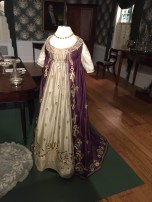 Regency regalia?
 Regency costume rentals.
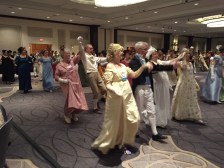 the camaraderie. I had a chance to meet two of my Facebook buddies whom I had never seen face-to-face before—and made new friends as well. Where else can you go to find people who get just as excited about Austen as you do? Or who are equally knowledgeable? Total strangers are interested in debating why a character did something or how the settings from two different books compare. Perhaps your household is different, but my family tends to start rolling their eyes after too much Austen talk. J There’s no such thing at JASNA.




 Victoria Kincaid